
 Menu
Menu Close
Close
About Wells Lifeboat Station
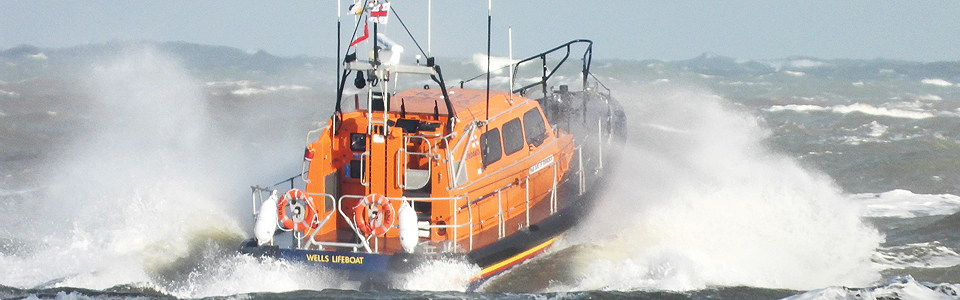
Situated at the eastern end of Wells beach, Wells Lifeboat Station is one of 238 operated by the RNLI around the UK's coast, providing emergency life-saving cover up to 50 miles off-shore. The station has two lifeboats; a Shannon-class all-weather lifeboat which can operate in all conditions with a range of over 250 miles and a small, fast inshore lifeboat.
The station is a new building completed in 2022 to house the new Shannon class lifeboat, replacing the station's previous all-weather lifeboat and historic boathouse.
Wells-next-the-Sea is a commercial port and former ship-building centre and is now the only major harbour along the North Norfolk coast. It retains a small fishing fleet and has been an active base for windfarm and work vessels as well as home to a good many leisure and private boats and yachts. The town and local coastline is also a popular holiday and tourist destination and busy in summer with swimmers, windsurfers, kayakers and walkers around the harbour, beaches and marshes.
The RNLI has kept a lifeboat at Wells for over 150 years.
Launching the lifeboats
The all-weather lifeboat is kept on a 'SLRS' (Shannon Launch and Recovery System), effectively a mobile slipway and recovery carriage with a permanently coupled tractor. If there is sufficient tide in the harbour when the lifeboat needs to launch, the lifeboat is taken down the ALB ramp into the channel. When necessary, the lifeboat can be launched and on its way in around 10 minutes.
If the tide is out, the SLRS, which is largely submersible and has four powered tank-like tracks, will take the boat and its crew to a suitable launch site on Holkham beach. This can mean a trip of up to two miles before the boat can launch, one of the longest beach launches of any UK lifeboat station, and can add 20 minutes or more to the launch time.
Wells has had a D-class inshore lifeboat since the early 1960s when this immensely successful type of lifeboat was first introduced. The D-class is able to operate close to the shore, in shallow water and surf and right onto the beach if necessary, as well as covering the many winding creeks within local harbours and marshes.
The D-class is ideal for rescuing people cut off by the tide, swimmers in difficulty, injured windsurfers or sailors and for locating lost children or people missing on the beach or marshes. Although described as an inshore boat, the ILB is entirely seaworthy and may launch to incidents along the coast from Brancaster to Blakeney or operate several miles offshore. It will sometimes launch alongside the all-weather lifeboat to assist in searches, to help recover persons or equipment from the water or to act as back-up or provide assistance as vessels are brought into harbour.
The ILB at Wells has traditionally been launched by its two or three man crew pushing the boat on its trolley into the water but with the new boathouse it is kept coupled to a Softrak launching vehicle. With the tide in, the boat can launched in a matter of minutes either in front of the boathouse using the main ramp or into the outer harbour using the smaller ILB ramp. With the tide out, the boat and crew can be towed to Holkham beach by the Softrak and launched there.
The RNLI
The Royal National Lifeboat Institution (RNLI) is a charity that exists to save lives at sea. It is unusual among emergency services in that it is funded entirely from public donations and that almost all its lifeboat crews and shore helpers are unpaid local volunteers... a tradition that has worked successfully for over 150 years.
At Wells, the station's has two full-time paid mechanics. The rest of the team; some 22 crew members, 8 shore helpers and six committee members and station officers as well as the local fund-raising Guild, shop staff and visitor guides are all volunteers. They give up much of their time not only to do the job but also for in-depth training and regular exercises that allow them to operate safely and effectively.
Wells Lifeboat crew and launchers are on stand-by 24 hours a day, every day of the year. If required they are summoned by radio pager and will quickly make their way to the boathouse, usually driving just over a mile to the end of the beach road and then running up to the boathouse.
Exercise Launches
You are welcome to watch the lifeboats launch on exercise from a safe distance on the beach bank or beach; please keep clear of the boats and launching vehicles and keep children and dogs under supervision. Exercises are roughly every two weeks and we try to post dates and times in advance when we can. All dates are subject to change or cancellation at short notice for operational reasons.
Sunday 12 Jul 2026 16:30
Annual Lifeboat Service
Thursday 30 Jul 2026 18:30
Regular exercise
Sunday 16 Aug 2026 08:30
Regular exercise
Thursday 27 Aug 2026 18:30
Regular exercise
Sunday 13 Sep 2026 08:30
Regular exercise
Sunday 27 Sep 2026 08:30
Regular exercise
This website is run and managed by local volunteers at Wells-next-the-Sea lifeboat station and is not owned or operated by the RNLI
The Royal National Lifeboat Institution (RNLI) is a charity, registered in England and Wales (209603) and Scotland (SC037736).
All text and images copyright (C)2000-2026 RNLI Wells Lifeboat Station or as otherwise indicated, and may not be downloaded, copied or reproduced elsewhere
without prior permission of the station or the relevant copyright holder.